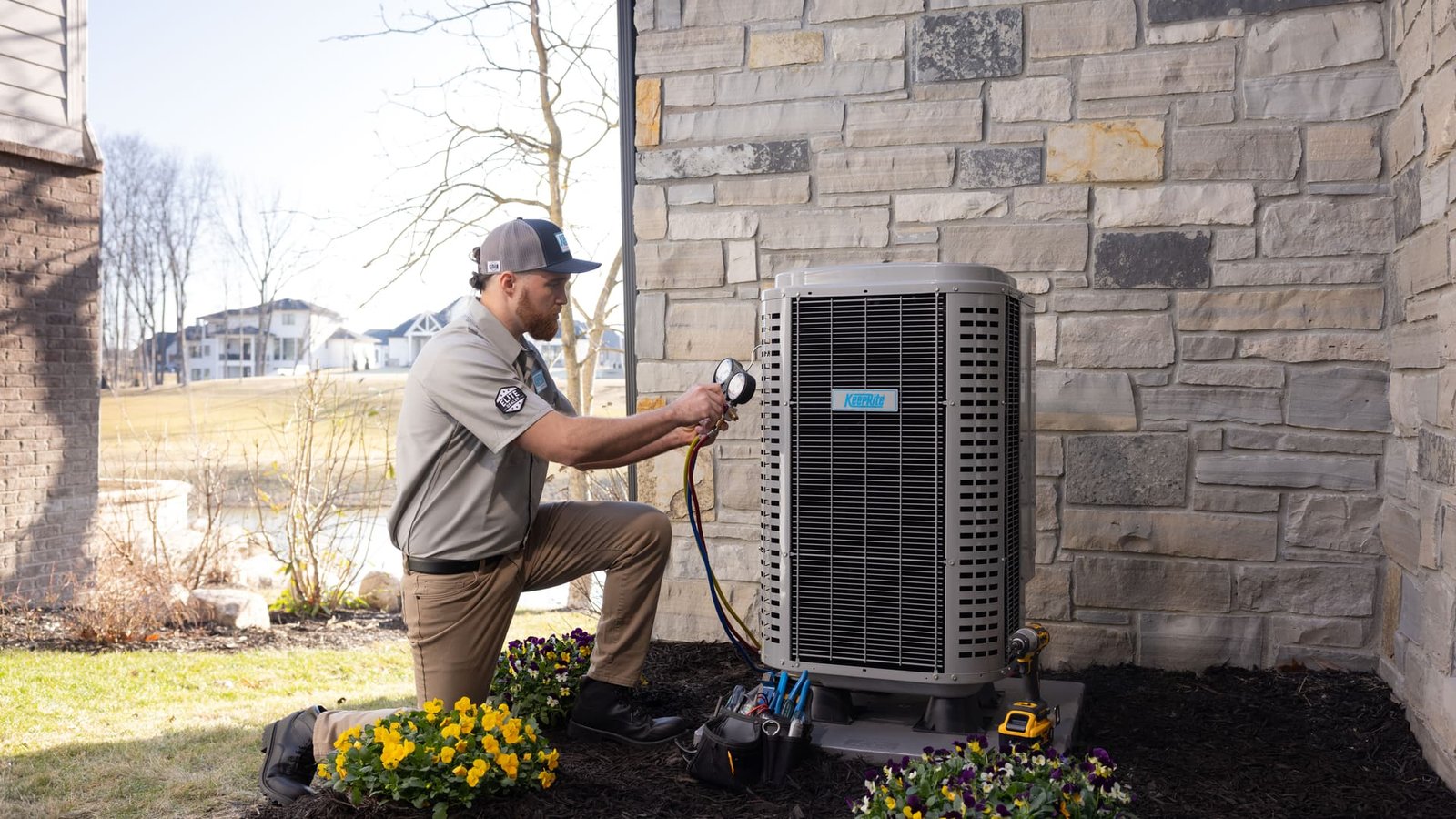
Licensed BermaxHVAC technician checking the refrigerant charge on a KeepRite condenser beside a stone-clad home

Priced,
not quoted.

Furnaces, air conditioning and heat pumps. Two licensed Ontario tradesmen, one install a week.

How big is your home?
Which system?

$13,782 – $16,565 Everything in, plus HST. Ten-year parts and labour. Tap your size and system for your own number.

Two ways to do it.

Same furnace, same crew, same ten-year warranty. The only choice is what sits outside.

Every price on this page is before HST.

The difference, line by line

What Furnace + air conditioning Furnace + heat pump
Price, installed $13,782 – $14,758 $15,337 – $16,565
Federal rebate Nothing. Only cold‑climate heat pumps qualify. $2,000 back
Difference up front The heat pump is $1,555 to $1,807 more to install, depending on the size of your home. Canada’s rebate pays $2,000 of that back, and pays nothing at all on the air conditioning — so once it arrives the heat pump has cost you $193 to $445 less. You claim it, not us, and payments start in 2027.
Heats the house Gas furnace, all winter Heat pump down to about −17 °C, where gas becomes the cheaper way to make heat, then the furnace
Coldest nights Gas furnace The same gas furnace, automatically
Cools the house Air conditioner The heat pump, running backwards
What you pay to run it All the heat is gas, or propane Most of the winter is electricity, the coldest part is the furnace
Difference to run On Ontario’s typical rates the gas furnace is the cheaper of the two to run. How that is worked out, and the fields for your own bills →
Moving parts outside One, used in summer One, used all year
Warranty Ten years, parts and labour Ten years, parts and labour
Time on site Two days Two days

Both figures are a typical Ontario house on Ontario’s typical rates, and they move when you put your own two numbers in. On delivered propane rather than a gas line they turn over completely: propane costs about three times as much per unit of heat as natural gas, and that is the case the heat pump wins outright.

In both prices

  • Sheet metal transitions formed for your furnace
  • Nitrogen-purged refrigerant brazing
  • Electrical whip and disconnect
  • Digital touchscreen thermostat
  • Vibration isolation pad
  • Both of us on site, start to finish

Not in either price

We price for a changeout, and the ordinary surprises are already in the number. Four things genuinely sit outside it, and they are rare:

  • Asbestos in or around the old equipment, which a licensed abatement contractor has to clear before we can work
  • No gas line to where the furnace goes
  • An electrical panel with no room for the circuit the new equipment needs
  • Ductwork that has to be rebuilt rather than adapted

If we find one at the site visit we tell you what it costs before anything is ordered, and you can take your deposit and walk away. We do not start the work and raise it afterwards.

The five parts, drawn and labelled →

$2,000 back on the heat pump, and up to $10,000 if your income qualifies — how Canada’s rebate actually works

Canada announced the National Heat Pump Rebate on 8 October 2026 and published its terms on 1 November. It pays $2,000 on a cold-climate heat pump installed on or after 1 November 2026, and nothing on an air conditioner — only cold-climate heat pumps are eligible.

Where a household’s after-tax income is at or below the median for Ontario and its household size, the rebate is more than $2,000, up to $10,000. Every figure on this site is worked out on the $2,000, because that is the part we can be certain of — so if the Canada Revenue Agency puts your household in the higher band, what you get back is more than any number printed here, not less.

What we do

  • Install equipment that qualifies. All four sizes of heat pump we fit are on Natural Resources Canada’s product list, classified ccASHP — cold climate — which is the only class the rebate covers.
  • Give you an invoice written to the programme’s specification: your name and address, our company name, the make, model and AHRI reference number, how many heat pumps, the total project cost including ductwork and electrical, and the installation date.

What you do

  • Apply yourself, at canada.ca, once the portal opens in early 2027. Installs from 1 November 2026 are covered retroactively.
  • Submit the receipt within six months of the work.

What we are not going to pretend

  • It is not a discount and we do not take it off your invoice. Canada pays you, after the fact, and nothing is paid until the portal opens. Knocking it off the price would mean us lending you money against a cheque written to somebody else.
  • Which band you are in is not ours to work out. The Canada Revenue Agency assesses it from your own tax return, against a social insurance number you give to them and never to us. We will not ask what you earn, we cannot tell you which band you land in, and anybody in this trade who tells you what your rebate will be is guessing at it.
  • It is one rebate per household, and Canada states that programme parameters and eligibility criteria are still being finalized and remain subject to change. The official page is the only thing that is current: canada.ca — National Heat Pump Rebate.
Getting three quotes? Eight questions that tell a cheaper job from a smaller promise

A cheaper number is sometimes a cheaper job and sometimes a smaller promise, and from the outside those look identical. These eight questions tell them apart. Ask us. Ask the other two.

1

Is that the final price, or a starting point?

Us: The published price is the price. Four things could change it, they are named on this page, and you can take your deposit and walk away from any of them.

2

Who will actually be in my house, and what are they licensed for?

Us: The two tradesmen who quoted it. TSSA Gas Fitter 1 & 2 and 313D refrigeration. Twenty years and thirty-seven years. No apprentice left alone with any of it.

3

How many other installs are you doing the day you do mine?

Us: None. One installation a week, and the week you hold is yours.

4

Did you do a heat-loss calculation, or size it off the old unit?

Us: Measured. And we size the heat pump on the cooling load, not the heating one, because the same box does both jobs.

5

Will the transition be formed for my furnace, or forced into a stock box?

Us: Formed to your furnace opening by a licensed 308A sheet metal mechanic. We buy it made, not off a shelf, and fit it on day one.

6

Will the brazed joints be nitrogen-purged, and will you pull a vacuum and prove it holds?

Us: Yes, on every joint, then deep vacuum and a decay test before any refrigerant goes in.

7

Does the labour warranty come from you, or only from the factory?

Us: Both. Ten years of factory parts, and ten years of our own labour.

8

Is HST inside the number you have written down?

Us: No, and we say so everywhere. Ask for the all-in figure from all three of us and compare those.

If somebody answers all eight the way we have and comes in under us, hire them. That is a good contractor and a better price, and we would rather you got one than got talked out of one.

Book your installation week.

You speak to the licensed technician who will be on your job. Never a call centre.

We install one home a week, Wednesday and Thursday. Call us for the next open week.

What the $500 covers, what could change the price, and how to cancel

Five things people want settled before they put $500 down. Settled here, before you pay, which is the only time it is any use.

Your $500 comes back

Refundable in full, for any reason, until we have visited your home. You do not need to give us a reason and we will not ask for one. It goes back the way it came, within five business days.

It is not a fee

The deposit holds one installation week and comes off your total when the job goes ahead. It buys nothing except the week — and while you hold it, nobody else can have it.

Four things could change the number. You can walk away from all four.

We price for a changeout, and the ordinary surprises are already in the number. These are the ones that genuinely sit outside it, and they are rare:

  • Asbestos in or around the existing equipment, which a licensed abatement contractor has to remove before we can work
  • No gas line to where the furnace goes
  • An electrical panel with no room for the circuit the new equipment needs
  • Ductwork that has to be rebuilt rather than adapted

If we find one of them at the site visit, we tell you what it costs before anything is ordered, and you can take your deposit back and walk away. We will not start the work and raise it afterwards.

Ten days, by law

If you sign the final agreement in your home, the Consumer Protection Act, 2002 gives you ten days from receiving your written copy to cancel it for any reason at all. Nothing we write anywhere reduces that.

Plus HST, and who you are paying

Prices on this site are before tax; your written agreement shows the total including it before you sign anything. We arrange the deposit with you directly once you have picked your week, and no card details are entered on this site. Paid to Bermax Retail Industries Inc., 6084 Hyndman Dr, Melbourne, Ontario.

That sheet is the plain-language summary in full, and it prints. The written agreement you receive before any work begins is the binding one, and nothing in either limits the rights Ontario law gives you as a consumer.

Direct line
(519) 702-4725

Immediate answers on sizing, availability, heat pump feasibility and scheduling.

Call now
Written estimate
BermaxHQ@gmail.com

Send your address, dimensions or photos of the existing equipment for a tailored review.

Email us

Is the heat pump
worth it?

A heat pump costs about sixteen hundred more to install than the air conditioner, and heats the house on electricity instead of gas or propane. Whether that is worth doing turns entirely on which of the two you burn now.

Which one heats the house now?
Those are typical figures. Work it out on my own bills.
L

Add up last year’s deliveries, or take it off your supplier’s annual statement. 3,600 L is a typical Ontario house on propane, water heater included.

L

The furnace is off in summer, so this is the water heater and the stove. Twelve of these come off the year, which leaves the heating — measured, not estimated.

¢/L

Last year’s total propane spend divided by the litres, so delivery, tank rental and HST are all in it.

¢/kWh

Same on the hydro bill: the year’s total divided by the kilowatt-hours.

How efficient is the furnace you have now?

Put your own meter and rates in and this gets a good deal closer than a rule of thumb — but it is still a model, and a year is a long time. Bring the bills when we come round and we will check it against what actually happened.

And it works in a Canadian winter.

You may have heard that heat pumps give up when it gets really cold. This one does not. It keeps heating down to −30 °C. On the coldest nights your furnace starts by itself and helps out. You do not have to do anything, and you never run out of heat.

Which system is heating your house, by outdoor temperature A temperature scale running from plus 10 degrees Celsius on the left to minus 30 on the right. From plus 10 down to about minus 17, the heat pump heats the house on its own; most Southwestern Ontario winter nights fall in this part of the scale. From about minus 17 down to minus 30, the gas furnace starts automatically and helps, so the house keeps up on the coldest nights. about −17 °C HEAT PUMP ALONE FURNACE HELPS +10°0°−10° −20°−30° most winter nights are in here

Rated to keep heating at −30 °C. The changeover point is set when we commission the system.

Two tradesmen.
Two days.

One with twenty years in the trade, one with thirty-seven, and no apprentice between you and the work. Here is the whole job in order, so nothing about it is a surprise — including the two moments that decide whether the system lasts, both measured before we leave.

Before · the site visitWe measure the house room by room and run the load calculation properly, look at the ductwork, and check the gas line and the electrical panel. Then you get the final price in writing. Nothing is ordered until you have read it, and your deposit is refundable in full right up to this point.

  1. Day one

    Wednesday

    The furnace

    Old equipment out. The new furnace set and levelled, the formed plenum transition fitted to your furnace opening, gas and venting connected, electrical run, thermostat in.

    Your gas is off for part of the day while the old furnace comes out. Your heat is back on the same evening. We do not leave a house cold overnight, and we will not start a changeout on a week we cannot finish.

    What that one piece of metal is worth, measured
    How the shape of one piece of ductwork changes the airflow Two cutaway views of the same furnace outlet meeting the same duct, with air flowing from left to right. In the upper one the outlet opens straight into a stock box, so the air cannot follow the sudden step: it carries on as a narrow jet through the middle and stalls in the corners above and below, turning over on itself instead of moving forward. The blower has to push against 0.90 inches water column. In the lower one the outlet is joined to the duct by a piece shaped to fit, so the air spreads gradually and fills the whole duct, and the blower pushes against only 0.45 inches water column — half the resistance for the same air. STOCK BOX air stalls in these corners 0.90" SHAPED TO FIT 0.45" HOW HARD THE BLOWER WORKS

    Same furnace, same ductwork, measured both ways: the stock box makes the blower push against twice the resistance. You hear that as noise, and feel it as the room at the end of the run never quite catching up.

    Static pressure 0.90" w.c. against 0.45", same blower speed.

  2. Day two

    Thursday

    The outdoor side, and commissioning

    Pad set and the condenser placed. The lineset run and brazed under flowing nitrogen, so no scale forms inside the pipe. Then deep vacuum and a decay test before a gram of refrigerant goes in — if the system will not hold a vacuum, it does not get charged.

    Before we leave

    Static pressure measured, airflow set, the refrigerant charge weighed in and verified, and the changeover point set for your house rather than left on the factory default. Every reading written down and left with you, so the next person who works on it knows what it was on day one.

    Why nitrogen, and what the alternative costs you

    Heat copper in open air and the inside of the pipe grows a crust. Bits of it break off, travel along with the refrigerant and end up in the compressor — the one part that is expensive to replace. We push nitrogen through every joint as we braze it, so there is no air inside to burn.

    What brazing in air leaves inside the pipe, and what nitrogen prevents Two cutaway lengths of copper refrigerant pipe at a brazed joint. In the upper one, brazed in open air, the inside wall is crusted with oxide scale and flakes of it are travelling along the bore towards the compressor. In the lower one, nitrogen flows through the pipe while the joint is heated, so no oxygen reaches the hot copper, no scale forms, and the bore stays clean. BRAZED IN AIR SCALE COMES OFF BRAZED WITH NITROGEN STAYS CLEAN

After · the paperworkThe manufacturer warranty registered in your name, which has to be done within the window or the ten years quietly becomes five. Your ten-year parts and labour, in writing, in your hands.

1 installation per week. By choice.

Most contractors run two or three installs a day. We book one system a week, so the two of us are on your house for two full days — sizing it, brazing it and commissioning it ourselves.

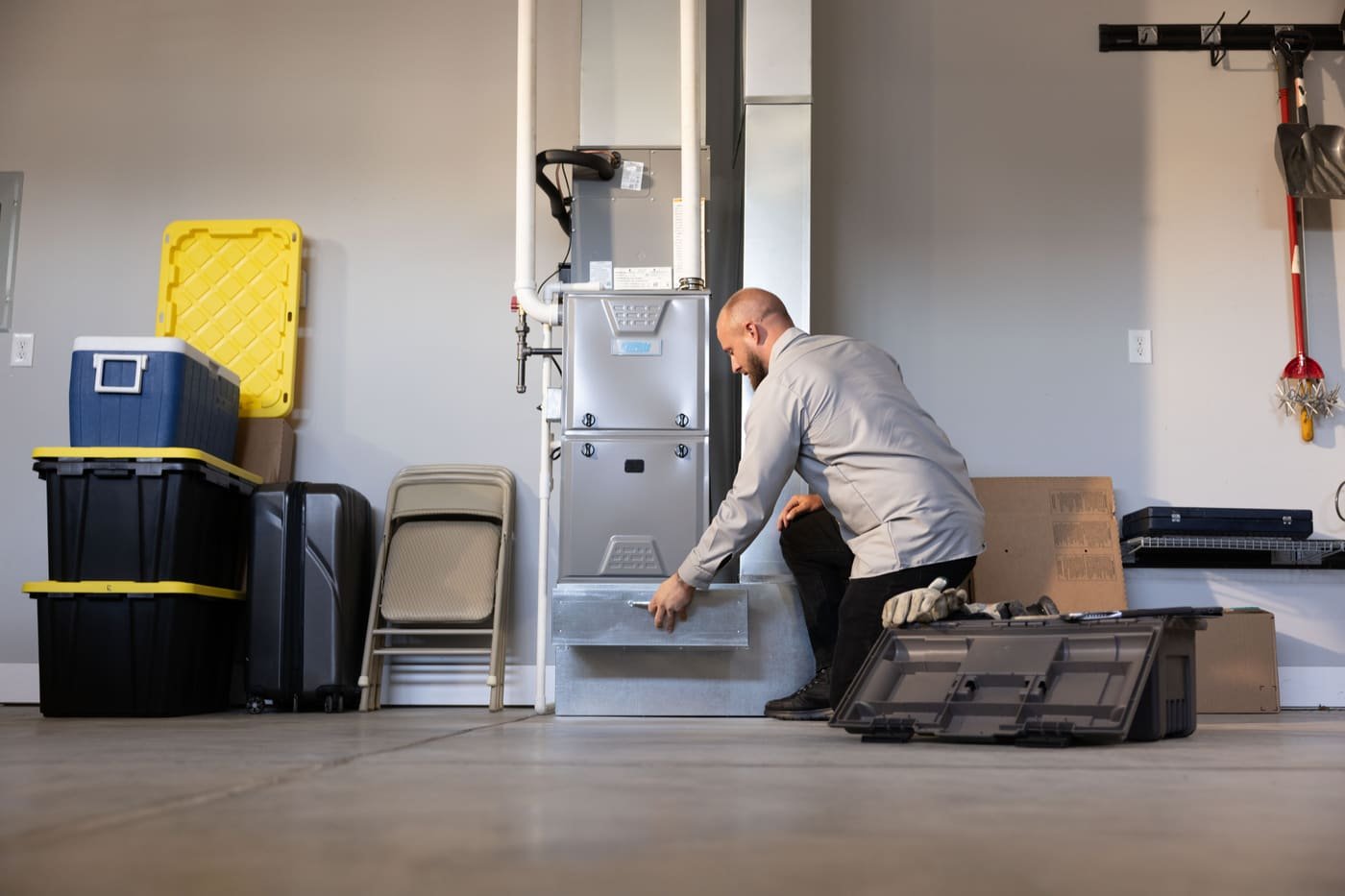
BermaxHVAC technician fitting a custom-formed sheet metal transition to a KeepRite gas furnace

Day two. The tradesman who sized the system is the one fitting it.

Who is actually in your house

Both days

The two of us

TSSA Gas Fitter 1 and 2, and the 313D air conditioning and refrigeration licence. Those are the tickets the law requires before anyone opens a gas line, sets a vent or handles refrigerant — which is every step above except the ductwork. Both sit on a public register under the company name, and we would rather you looked us up before you book than after.

The one we don’t do ourselves

The sheet metal

Ductwork is its own trade with its own ticket, 308A, and we do not hold it — so we do not make your transition. We buy it formed to your furnace opening by a licensed sheet metal mechanic who does that and nothing else, and we fit it on day one. A stock box off the shelf would be cheaper and quicker. Day one has the measurement that says what the better piece is worth.

If something breaks

The same two people come back.

Not a dispatcher, not a subcontractor, not whoever is free that week. The two tradesmen who installed it are the two who come and fix it, on (519) 702-4725.

Ten years

of our own labour. You pay nothing — not for the part, and not for the hours.

Ten years

of KeepRite parts, and the furnace heat exchanger for as long as you own it.

Ninety days

to register it, or the ten years quietly becomes five. We do it before we leave.

The ten years start the day we commission it, not the day you call.

What each of those three leaves out

Ten years of our own labour

A free part is not much use when the bill for fitting it is four hundred dollars. That is the half most companies leave out, and it is the half that decides what a breakdown in year seven actually costs you.

Ten years of KeepRite parts

The heat exchanger is the part that would otherwise mean buying another furnace, which is why its cover runs as long as it does. And for the first five years it is no-hassle replacement: if the compressor, the coil or the heat exchanger fails, KeepRite replaces the unit rather than repairing it.

Ninety days to register

It is the installer’s job, not yours, and it takes about five minutes. Miss the window and the parts warranty drops from ten years to five, and the heat exchanger from lifetime to twenty years. We do it before we leave and send you the confirmation, so you never find out in year six that you had half the warranty you thought you had.

Hold a week

Questions, answered.

How much does a new furnace and air conditioner cost in Ontario?

Ours are published, not quoted: $13,782 to $14,758 for a furnace and air conditioner, and $15,337 to $16,565 for a furnace and heat pump, depending on the size of the house. Plus HST. That is the whole job — equipment, sheet metal, thermostat, electrical, the pad, and ten years of parts and ten years of our own labour. Nothing is added after the site visit.

How much is the heat pump rebate in Canada, and who claims it?

$2,000 on a cold-climate heat pump, and up to $10,000 if your household income qualifies. You claim it, not us — we are not a middleman on your rebate and we do not price as though we were. The air conditioning package is not eligible, so we do not pretend it is.

What is included in the price of a new furnace and air conditioner?

Everything. The furnace, the outdoor unit, and the coil that matches it. The sheet metal, formed to fit your furnace. The thermostat, the electrical hookup, and the pad it stands on. Then ten years of parts and ten years of our own labour. Two of us, on your house, for two days.

Eight more, if you want them

Do heat pumps work in an Ontario winter?

Yes. The cold-climate heat pump we install keeps heating down to −30 °C. It is paired with a gas furnace, and on the coldest nights the furnace starts by itself and takes over, so the house never falls behind. You do not have to switch anything.

What licences should a furnace installer in Ontario hold?

Two of our own, and a third we bring in. Gas Fitter 1 and 2 from the TSSA, which covers every gas pressure in a home, and the 313D air conditioning licence, for refrigerant work — both held by the two tradesmen who do your install. Ductwork is a third trade, 308A sheet metal, and we do not hold it: the transition is formed for your furnace by a licensed sheet metal mechanic, and we fit it.

How long does it take to install a furnace and air conditioner?

Two days — Wednesday and Thursday — and the same two of us are on your house for both of them and nowhere else that week. Most companies book two or three installs into a single day. We do one house a week, about fifty a year, which is the only reason we can put our own name on a ten-year labour warranty.

What does a furnace and air conditioner warranty actually cover?

Two warranties. KeepRite gives ten years on parts, a lifetime on the furnace heat exchanger, and five years where they replace a failed unit rather than repair it. We give ten years of our own labour. So if something fails, you pay nothing for the part and nothing for the hours. The manufacturer terms depend on the equipment being registered within ninety days, which we do before we leave.

Is there financing on a new furnace or heat pump?

Yes. Six months at no interest, on any complete system we install.

Can I replace just the furnace and keep my old air conditioner?

No, and it is worth saying why. The furnace, the coil and the outdoor unit are rated as a matched set, so a new furnace under an old coil has no efficiency rating at all. You would also be opening the same system twice — paying for the refrigerant work and the disruption now, and again in a few years. We do it once instead, and the price covers the whole system. If your furnace has failed and your cooling is nearly new, call us and we will tell you honestly whether waiting is the better move.

My furnace stopped working — can you come out today?

Probably not, and we would rather say so than waste your evening — we install one home a week and those weeks are booked ahead. Call us anyway on (519) 702-4725. Everything worth doing tonight, including four checks you can make yourself, is on the no-heat page.

Which areas of Southwestern Ontario do you cover?

Southwestern Ontario, between Lake Erie and Lake Huron. That means London, St. Thomas, Strathroy, Sarnia, Chatham-Kent, Tillsonburg, Wallaceburg, Port Stanley and Grand Bend.

The towns BermaxHVAC installs in, between Lake Huron and Lake Erie A map of southwestern Ontario between Lake Huron to the north west and Lake Erie to the south. The shop is at Melbourne, in the middle. Grand Bend sits on the Lake Huron shore at the top. Sarnia is on the west edge at the head of the St. Clair River, with Wallaceburg and Chatham-Kent to the south of it. London is east of centre, with Strathroy between London and the shop, St. Thomas below London, Port Stanley on the Lake Erie shore below St. Thomas, and Tillsonburg on the east edge. Grand Bend to Chatham-Kent is about 105 kilometres in a straight line. LAKE HURON LAKE ERIE Melbourne our shop Grand Bend Sarnia London Strathroy Tillsonburg St. Thomas Port Stanley Wallaceburg Chatham-Kent 25 km

Grand Bend to Chatham-Kent is about 105 km in a straight line. If your town is not on the map, call and ask — we will tell you straight whether we can get to you.

Still comparing

Then take our answers to the other two quotes.

Eight questions on one sheet, with our answers already filled in and two blank columns for theirs. Print it, take it to the next appointment, and write down what they say.

Hold a week

Call (519) 702-4725
(519) 702-4725